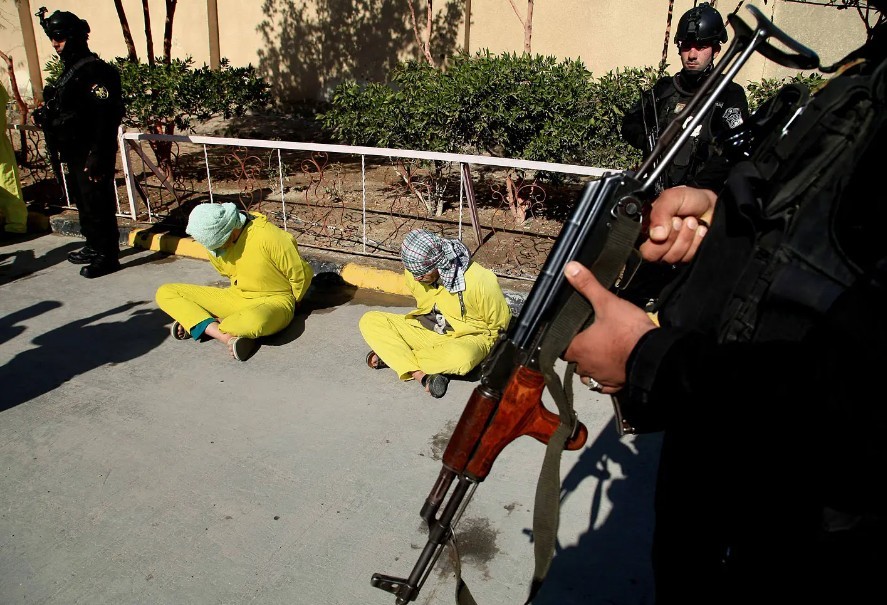

Iraq has received custody of 2,250 Islamic State (ISIS) members from Syria, a development that security analysts say highlights the continuing terror threat facing the country and the deep vulnerabilities of its security apparatus more than a decade after ISIS’s territorial defeat.
A terrifying scene unfolded yesterday in western Iraq’s Al‑Qaim district when a suspected Islamic State (IS) operative detonated an explosive belt during a security raid, injuring two members of the Iraqi security forces as they attempted to arrest him.
In a continued sign that violent extremist threats remain active despite the territorial defeat of the Islamic State, Iraqi security forces carried out coordinated counter‑terrorism actions across western and northern Iraq on 6 February 2026, resulting in the killing of multiple militants and suicide resistance by others, underscoring persistent terror dangers inside Iraq.
A major indicator of failed long‑term control of terrorism in Iraq emerged when the U.S. Department of Defense announced plans to significantly draw down American forces in the country, shifting responsibility for anti‑ISIS operations primarily to Iraqi security forces. This move highlights ongoing concerns that Iraq may not yet be capable of fully containing the extremist threat alone.
A brutal and shocking attack marred the annual Akitu (Assyrian New Year) celebrations in the city of Duhok, northern Iraq, when a lone assailant wielding a large cleaver began attacking festival-goers, injuring multiple people in an act of extremist violence.
A deadly attack by suspected Islamic State (ISIS) militants struck an Iraqi army post in eastern Iraq, killing five members of the Iraqi military and wounding several others, in one of the more severe terror incidents to hit the country since the official defeat of ISIS’s territorial “caliphate.”
Iraq has received custody of 2,250 Islamic State (ISIS) members from Syria, a development that security analysts say highlights the continuing terror threat facing the country and the deep vulnerabilities of its security apparatus more than a decade after ISIS’s territorial defeat.
A terrifying scene unfolded yesterday in western Iraq’s Al‑Qaim district when a suspected Islamic State (IS) operative detonated an explosive belt during a security raid, injuring two members of the Iraqi security forces as they attempted to arrest him.
In a continued sign that violent extremist threats remain active despite the territorial defeat of the Islamic State, Iraqi security forces carried out coordinated counter‑terrorism actions across western and northern Iraq on 6 February 2026, resulting in the killing of multiple militants and suicide resistance by others, underscoring persistent terror dangers inside Iraq.
A major indicator of failed long‑term control of terrorism in Iraq emerged when the U.S. Department of Defense announced plans to significantly draw down American forces in the country, shifting responsibility for anti‑ISIS operations primarily to Iraqi security forces. This move highlights ongoing concerns that Iraq may not yet be capable of fully containing the extremist threat alone.
Iraq has received custody of 2,250 Islamic State (ISIS) members from Syria, a development that security analysts say highlights the continuing terror threat facing the country and the deep vulnerabilities of its security apparatus more than a decade after ISIS’s territorial defeat.
A terrifying scene unfolded yesterday in western Iraq’s Al‑Qaim district when a suspected Islamic State (IS) operative detonated an explosive belt during a security raid, injuring two members of the Iraqi security forces as they attempted to arrest him.
In a continued sign that violent extremist threats remain active despite the territorial defeat of the Islamic State, Iraqi security forces carried out coordinated counter‑terrorism actions across western and northern Iraq on 6 February 2026, resulting in the killing of multiple militants and suicide resistance by others, underscoring persistent terror dangers inside Iraq.
A major indicator of failed long‑term control of terrorism in Iraq emerged when the U.S. Department of Defense announced plans to significantly draw down American forces in the country, shifting responsibility for anti‑ISIS operations primarily to Iraqi security forces. This move highlights ongoing concerns that Iraq may not yet be capable of fully containing the extremist threat alone.